
What You'll Learn
The CCNA 200-301 exam covers five core domains. Every topic below is taught step-by-step — from zero to exam-ready.
Network Fundamentals & Access
Network Infrastructure and Connectivity
Build the foundation every network engineer needs. You'll understand how data moves across networks, the OSI and TCP/IP models, and how to configure Ethernet and wireless connections.
Skills you'll gain
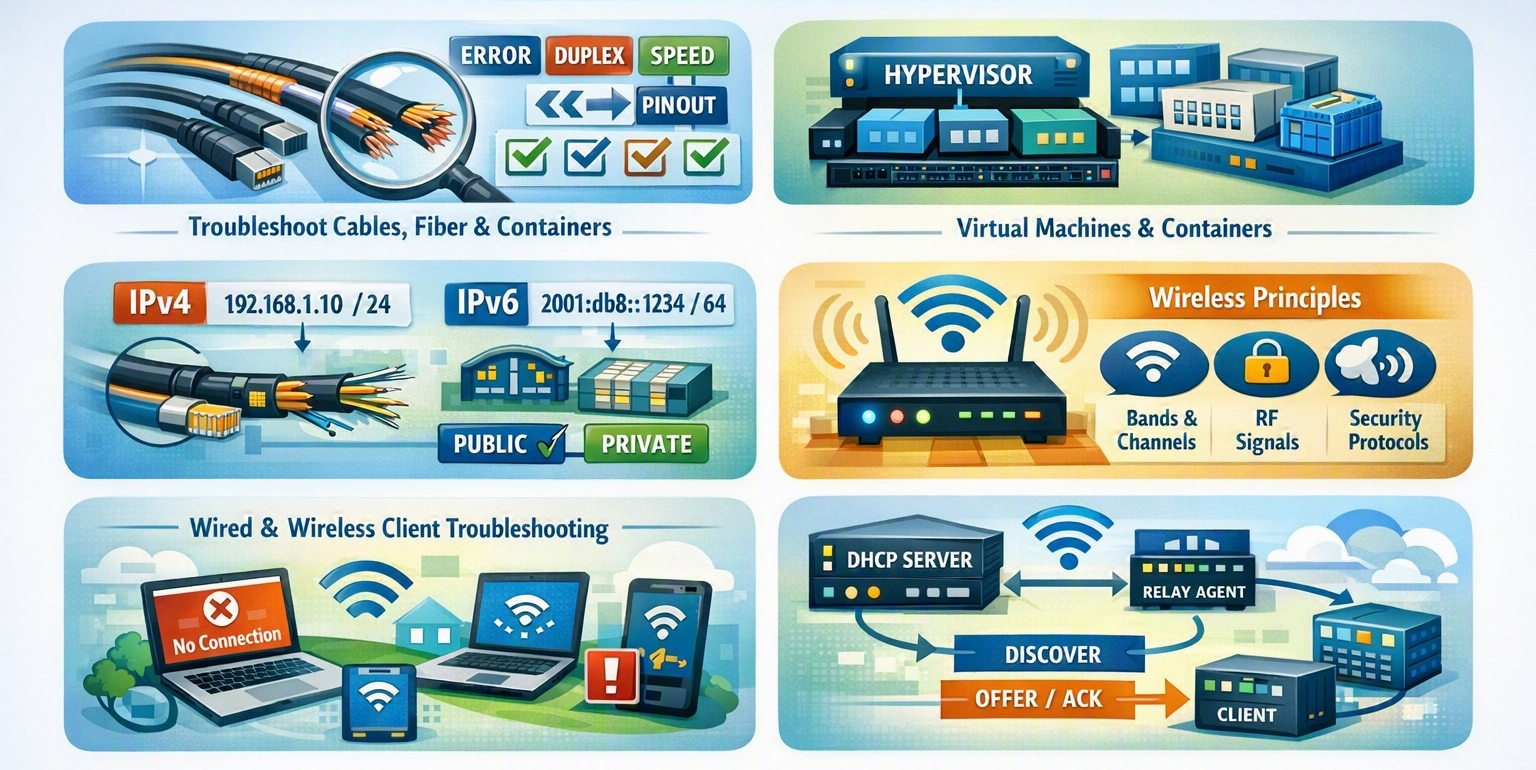
- 1.1 Diagnose interface and cable (copper and fiber) issues such as collisions, errors, mismatched duplex, speed, distance, interface, signal levels, pin out, and cable types.
- 1.2 Describe the role and function of hypervisors, virtual machines, and containers.
- 1.3 Troubleshoot IPv4 address configuration, assignment, and subnetting (public and private).
- 1.4 Troubleshoot IPv6 address configuration, assignment, and prefix sizing (unicast and modified EUI 64).
- 1.5 Describe wireless principles.
- 1.6 Troubleshoot wired and wireless client connectivity (IP configuration, network reachability, and wireless security parameters on Windows, MacOS, and Linux).
- 1.7 Troubleshoot DHCPv4 client, server, and relay on IOS devices.
Modules covered
Network Access & Layer 2
Switching & Network Access
Master Layer 2 switching — the backbone of every enterprise LAN. Learn how switches forward frames, how VLANs segment traffic, and how Spanning Tree Protocol prevents loops.
Skills you'll gain
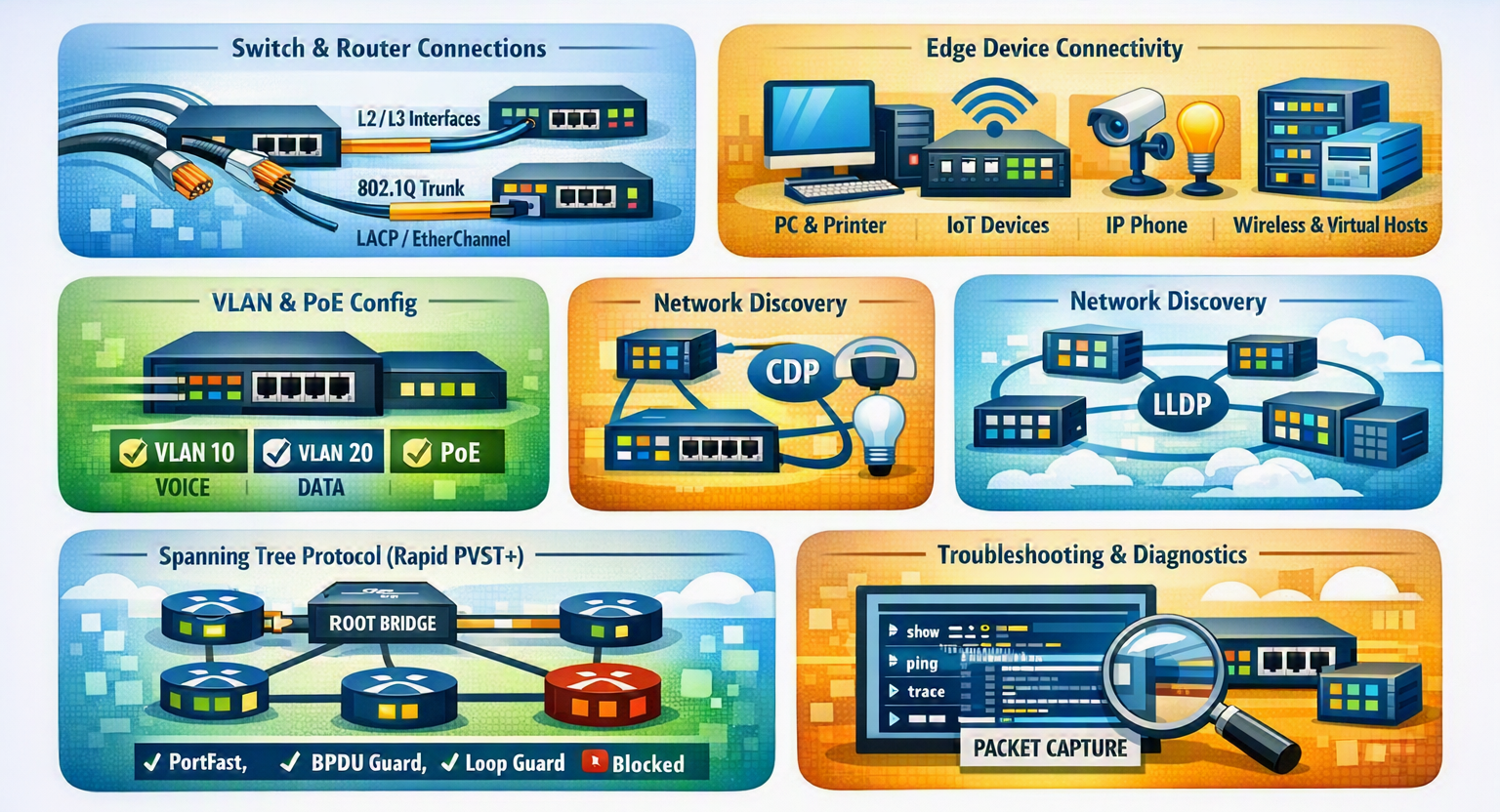
- 2.1 Configure network infrastructure connectivity (switch-to-switch and switch-to-router).
- 2.2 Configure Layer 2 switch port attributes for edge-host connectivity (VLAN, PoE, port channel, and LACP).
- 2.3 Validate the accuracy of network documentation using CDP and LLDP.
- 2.4 Troubleshoot basic Layer 2/Layer 3 connectivity and device operations using show commands (including show logs), ping, extended ping, trace route, and packet capture output.
- 2.5 Configure operations of the Rapid Per VLAN Spanning Tree Protocol (Rapid PVST+).
Modules covered
IP Connectivity
IP Routing
The largest exam domain — and the most rewarding to master. You'll configure static routes, deploy OSPF in single and multi-area designs, and understand how routers make forwarding decisions.
Skills you'll gain
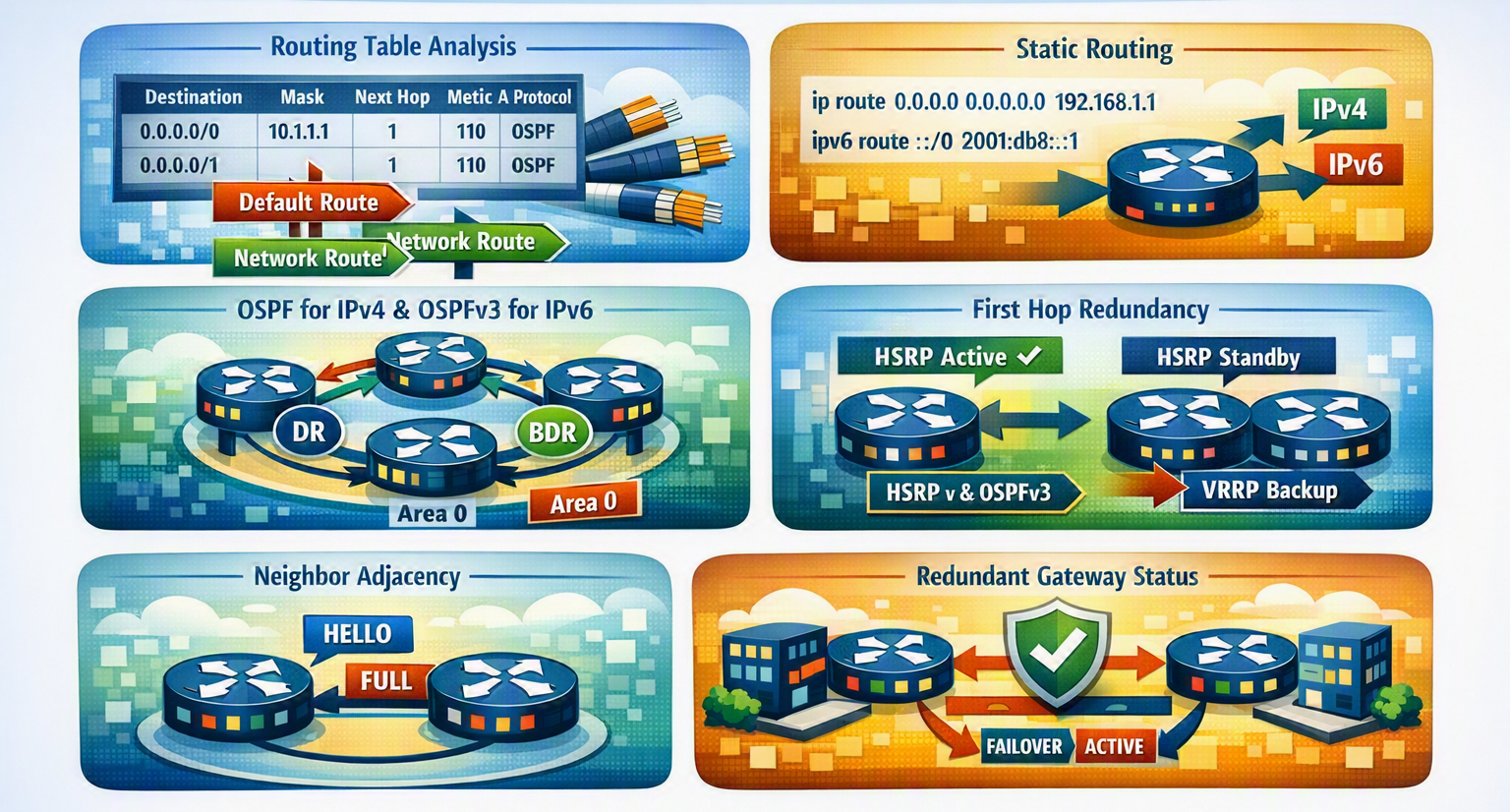
- 3.1 Interpret a routing table to identify the next hop for a packet (routing protocol, prefix/mask, administrative distance, metric, and default route).
- 3.2 Troubleshoot IPv4 and IPv6 static routing.
- 3.3 Configure single area OSPFv2 for IPv4 and OSPFv3 for IPv6.
- 3.4 Interpret the operational status of First Hop Redundancy Protocols (HSRP and VRRP).
Modules covered
IP Services & Security Fundamentals
Network Services & Security
Learn the services that keep networks running — DHCP, DNS, NAT, NTP — and the security principles that protect them. You'll configure ACLs, understand VPNs, and apply Cisco security best practices.
Skills you'll gain
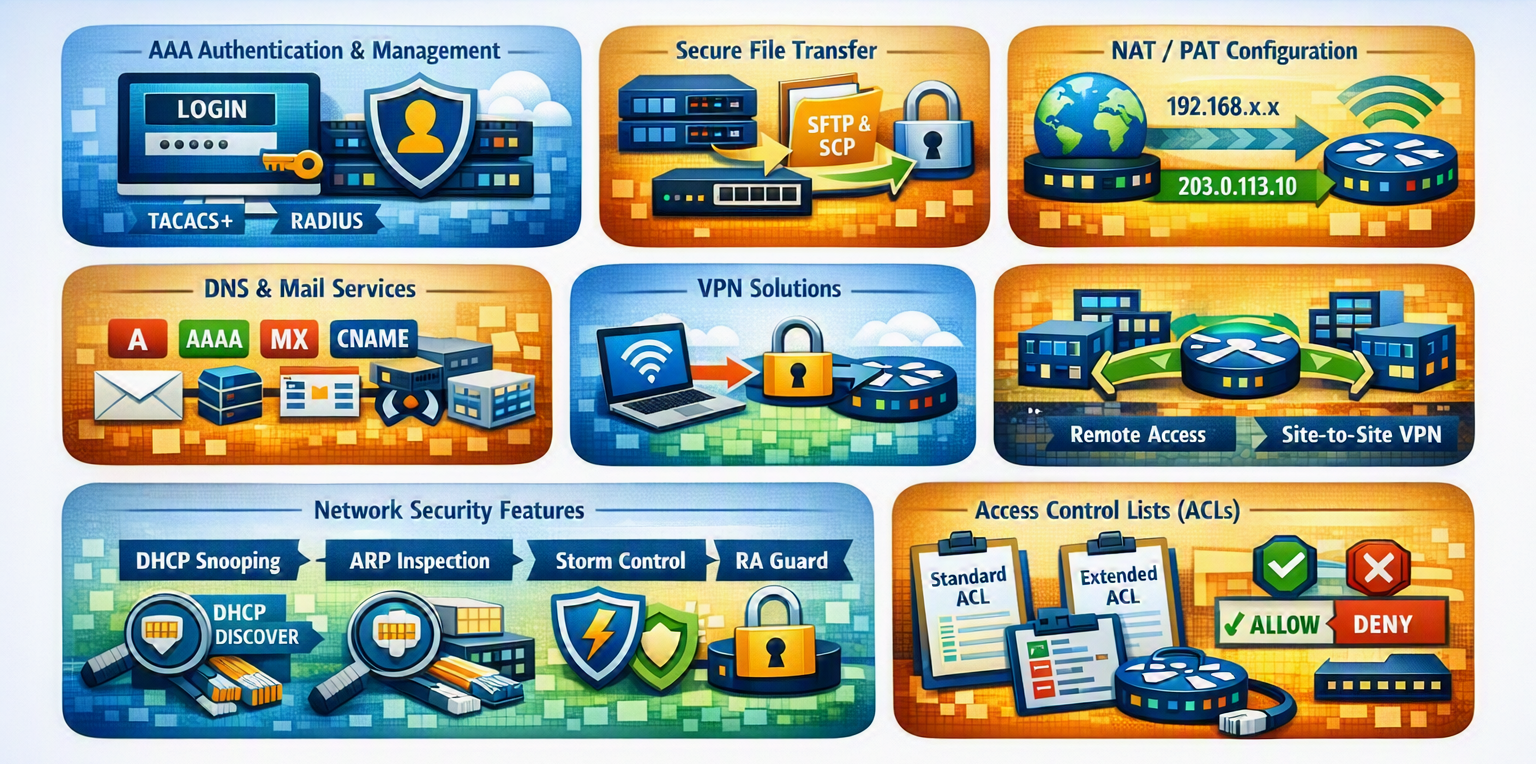
- 4.1 Configure network devices with local usernames and as an AAA client (TACACS+ and RADIUS) for management.
- 4.2 Manage device configuration and software files using secure file transfer operations with SFTP/SCP.
- 4.3 Configure NAT/PAT on IOS XE routers.
- 4.4 Diagnose issues with DNS records (A, AAAA, CNAME, MX, NS, and PTR) to support host, web application, and mail server access by name.
- 4.5 Describe IPsec remote access and site-to-site VPNs (protocols and transport modes).
- 4.6 Configure IPv4 access control lists (standard, extended, numbered, and named ACLs).
- 4.7 Configure Layer 2 security features.
Modules covered
Automation & Programmability
AI & Network Operations and Management
The future of networking is automated. Learn how SDN, Cisco DNA Center, REST APIs, and Python scripting are transforming how networks are managed — and what you need to know for the exam.
Skills you'll gain
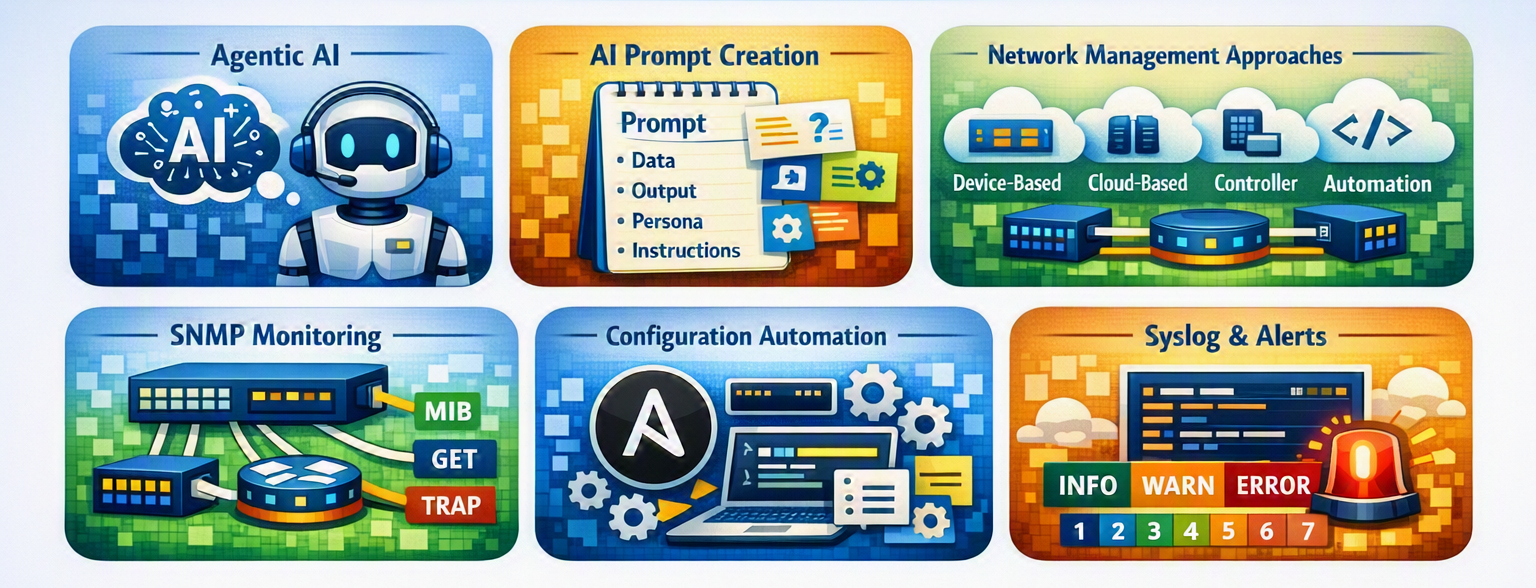
- 5.1 Describe the role of agentic AI in network operations.
- 5.2 Select a prompt to send to a generative AI system to support network operations considering prompt components such as data classification, output format, persona, and instructions.
- 5.3 Describe network management approaches (device-based, cloud-based, controller based, automation-based, and infrastructure as code).
- 5.4 Describe the function of SNMP in network operations.
- 5.5 Use configuration management mechanisms such as Ansible to execute commands.
- 5.6 Interpret syslog message content, severity levels, and facilities.
Modules covered
Ready to start your CCNA journey?
Join Luis Quiroz and learn every topic above — step by step, at your own pace.